
Odoo vs SAP Business One: Which ERP Is Better for UAE SMEs?
Reading Time: 11 min
 Share this article
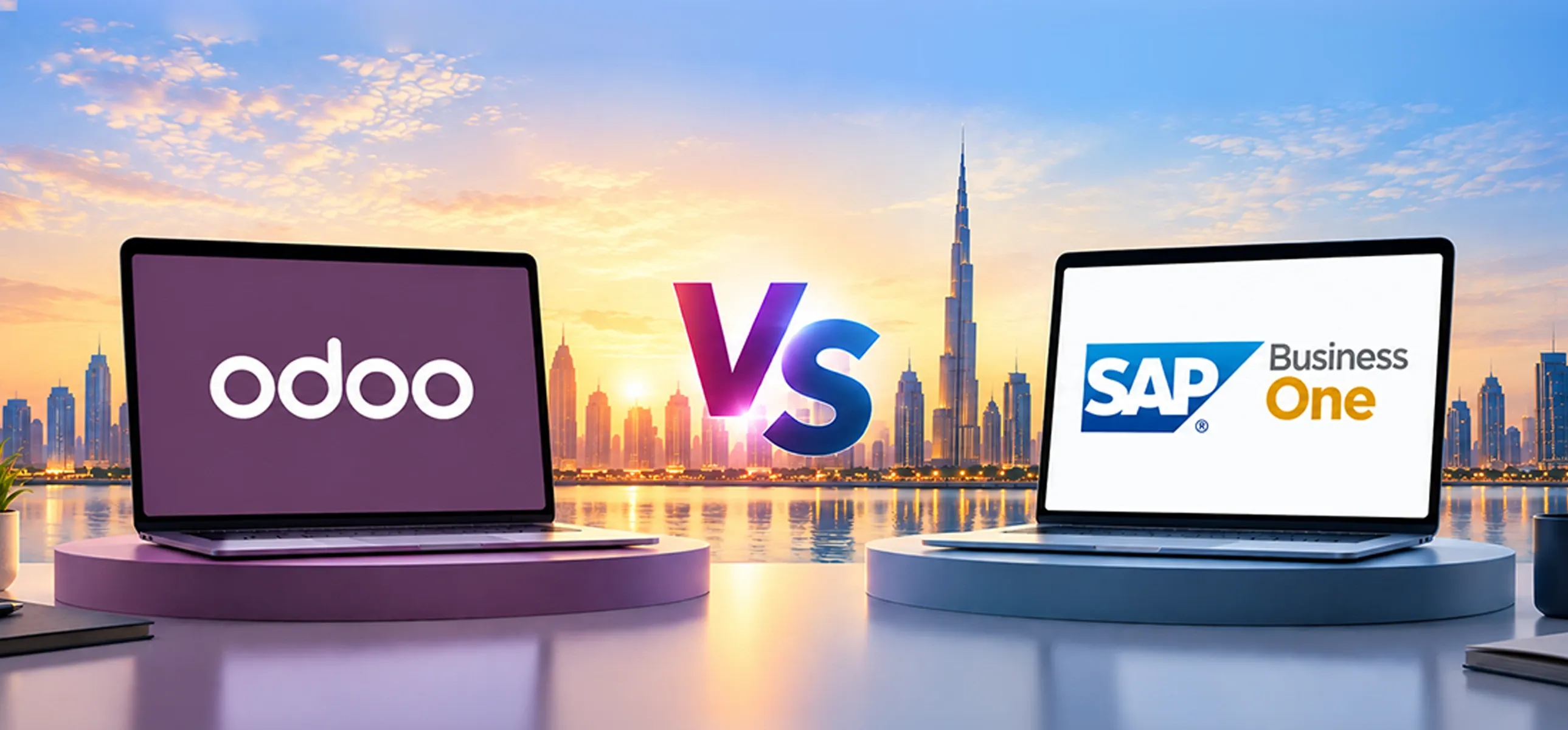
Choosing an ERP system is one of the harder decisions a growing business makes. For small and medium enterprises in the UAE, the choice usually comes down to two names: Odoo and SAP Business One. Both are built for the SME and mid-market tier, both can run your finance, inventory, sales, and operations from one place, and both have an established partner network in the region.
The difficulty is that "better" depends entirely on your situation. A five-person trading company and a fifty-person manufacturer are solving different problems, working with different budgets, and facing the same tightening set of Federal Tax Authority rules. This comparison of Odoo vs SAP Business One looks at what separates the two ERP software options for a UAE business: real cost, local compliance, implementation, and long-term flexibility. The goal is to help you decide which one fits, rather than to declare a single winner.
Odoo and SAP Business One at a Glance
Odoo is an open-source ERP built on a modular structure. You start with the applications you need such as accounting, inventory, CRM, or manufacturing, and add more as you grow. Because the source code is accessible, the system can be customised to match how a business already works, and it can be hosted in the cloud or on your own servers. Odoo reports a global user base in the millions across its Community and Enterprise editions.
SAP Business One is a proprietary ERP designed for standardised, process-driven operations. It offers deep financial controls and sits within the wider SAP ecosystem, which matters if a business already uses SAP products or plans to. Customisation and changes generally run through certified SAP partners rather than in-house developers. SAP states that Business One is used by tens of thousands of companies worldwide.
Put simply, Odoo leans toward flexibility and lower entry cost, while SAP Business One leans toward standardisation and structured financial depth. The rest of this comparison shows where each of those tendencies helps or hurts a UAE SME.
Head-to-Head Comparison
The table below summarises the main differences. The figures are typical ranges reported by implementation partners and comparison studies rather than fixed prices, and they vary with user count, modules, and the complexity of your setup.
| Factor | Odoo | SAP Business One |
|---|---|---|
| Licensing model | Open-source; subscription (Enterprise) | Proprietary; subscription or perpetual licence |
| Per-user cost | Lower end of the market | Higher per-user pricing |
| Year 1 UAE implementation | Lower typical range | Higher typical range |
| 5-year total cost of ownership | Generally lower | Generally higher |
| Implementation time | Faster for simple setups | Comparable for complex projects |
| UAE VAT | Native localisation module | Configuration or add-ons |
| E-invoicing readiness | Peppol/PINT-AE connectors available | Middleware or ASP integration |
| Arabic support | Full right-to-left interface, bilingual invoices | More limited |
| Manufacturing | Native MRP | Advanced features often via add-on |
| Customisation | In-house or partner, open code | Partner-dependent, closed code |
| Scalability | Scales within the platform | Scales within the SME tier |
The sections that follow expand the rows that need explanation, starting with the one most businesses ask about first.
What It Really Costs: Pricing and Five-Year TCO
Cost is usually the deciding factor, and it is also where the two systems separate most clearly. Odoo's per-user subscription sits at the lower end of the ERP market, while SAP Business One's per-user pricing is considerably higher, whether taken as a cloud subscription or a perpetual licence. First-year implementation in the UAE follows the same pattern: an Odoo project for a small to mid-sized team typically costs a fraction of an equivalent SAP Business One rollout. Over a five-year horizon, the total cost of ownership for SAP Business One is frequently several times that of Odoo for comparable functionality.
The headline licence price, though, is not the whole story, and two hidden costs deserve attention.
The first is SAP Business One's annual maintenance, commonly charged as a percentage of the licence value from the second year onward. Over five years this adds up and belongs in any honest budget comparison. Odoo's subscription includes updates, but it carries its own ongoing costs: hosting, and the upkeep of any custom modules you commission.
The second is a common misunderstanding about Odoo being "free." Odoo Community is open-source and free to download, but it lacks features that a UAE business needs, including VAT reporting and the tools tied to e-invoicing compliance. For a compliant, supported setup, most UAE SMEs need Odoo Enterprise. Budgeting on the assumption that Odoo costs nothing leads to an unpleasant surprise later. The realistic comparison is Odoo Enterprise against SAP Business One, and on that basis Odoo still tends to be the lower-cost option.
UAE Compliance: VAT, Corporate Tax, and E-Invoicing
For a UAE business, compliance is not a feature to compare casually. It is the reason the ERP exists, and it is where local specifics matter more than any general feature list. If you want a wider view of how ERP is helping SMEs in the region keep up with these rules, our guide on how ERP systems are driving operational efficiency for Middle East SMBs covers the broader picture.
VAT. The UAE applies a standard VAT rate of 5%, with mandatory registration once taxable supplies pass AED 375,000 in a rolling twelve-month period. Registered businesses must file periodic returns through the FTA's EmaraTax portal and show their Tax Registration Number on tax invoices. Odoo includes a UAE localisation module that handles VAT calculation, the standard, zero-rated, and exempt categories, and VAT return reporting out of the box. SAP Business One supports UAE VAT as well, but this generally relies on configuration or add-ons rather than native localisation.
Corporate tax. The UAE levies a 9% corporate tax on taxable income above AED 375,000, with a 0% rate below that, applying to financial years beginning on or after 1 June 2023. Both systems can be set up to support corporate tax reporting; Odoo's UAE localisation covers it more directly, while SAP Business One typically requires additional configuration.
E-invoicing. This is the most pressing item on the calendar. The UAE is rolling out mandatory e-invoicing in phases under a Peppol-based model, with invoices issued in the structured PINT-AE format and exchanged through an Accredited Service Provider. A voluntary pilot phase opened on 1 July 2026. Large businesses with annual revenue of AED 50 million or more must appoint an ASP by 30 October 2026 and go live from 1 January 2027, while smaller businesses follow from 1 July 2027. Paper invoices, PDFs, and scanned copies do not qualify. A penalty framework for non-compliance has been established in law.
The practical difference is readiness. Odoo has connectors for the Peppol network and PINT-AE format available through its ecosystem, so the path to a compliant e-invoice is relatively short. SAP Business One generally reaches compliance through middleware or a separate ASP integration project, which adds cost and time.
Three more UAE details often decide the outcome. FTA tax invoices are expected in Arabic and English, and Odoo produces bilingual invoices with a full right-to-left interface, whereas SAP Business One's Arabic support is more limited. Payroll must work with the Wage Protection System, which Odoo handles within its payroll module. And free zone businesses have specific VAT treatment that Odoo's localisation accounts for. None of these is impossible in SAP Business One, but each tends to require extra work.
Implementation, Customisation, and Vendor Lock-In
Beyond cost and compliance, two questions shape the long-term experience: how quickly you get value, and how free you are to change the system later.
On timelines, a straightforward Odoo setup can go live faster than a comparable SAP Business One project, particularly for smaller teams with standard requirements. For complex, multi-department rollouts the two are closer, and both usually run over several months. Worth remembering across either platform: a large share of ERP projects run late or over budget, most often because of scope creep, poor data migration, or thin user training rather than the software itself. A phased rollout, starting with one or two modules, reduces that risk regardless of which system you pick.
Customisation is where the open-source and proprietary models genuinely diverge. Odoo is built on Python, a widely used language, so developers are easier to find and hourly rates tend to be lower. SAP Business One customisation runs through certified partners and generally costs more per hour. This connects directly to vendor lock-in: with Odoo you own your code and are not tied to a single provider, while SAP Business One keeps you within a partner-dependent, proprietary environment.
Lock-in also matters when you outgrow the system. SAP Business One is built for the SME tier; moving beyond it usually means migrating to a larger SAP product, which is a costly and involved project. Odoo is designed to scale within the same platform by adding users and modules, so growth does not force a change of system.
Which One Fits Your Business? A Decision Framework
The honest answer is that there is no single best ERP, only the best fit for a given business. SAP Business One is the stronger choice in specific situations: if you need very deep general-ledger and financial controls beyond what most SMEs use, if your organisation already runs on SAP products, or if your operations are highly standardised and unlikely to need much customisation. In those cases its structure and financial depth are real advantages.
For the majority of UAE SMEs, though, the local factors point toward Odoo. A useful way to test your own case:
- Working with a tight first-year budget? Odoo is usually the only option that fits comfortably.
- Need an Arabic interface and bilingual invoices? Odoo handles this natively.
- Facing the e-invoicing deadline with limited time? Odoo's connectors shorten the path to compliance.
- Running manufacturing with production planning and routings? Odoo includes MRP natively; SAP Business One often needs an add-on.
- Already invested in the SAP ecosystem, or need exceptional financial-control depth? SAP Business One earns a close look.
- Planning to scale past the SME tier over time? Both work, but Odoo grows within the platform rather than requiring a migration.
A few worked examples make the pattern concrete. A small trading company with a handful of users can run a compliant Odoo setup for a fraction of a comparable SAP Business One rollout. A mid-sized manufacturer needing MRP gets those capabilities natively in Odoo, whereas SAP Business One typically reaches the same point through a paid add-on. A larger multi-company business finds the five-year total cost of ownership meaningfully lower on Odoo. In each case the deciding factor is not which system is more capable in the abstract, but which one meets UAE requirements at a cost that matches the business.
Conclusion
There is no universal answer to which ERP is better, because the right choice depends on your budget, your industry, your compliance obligations, and how you expect to grow. SAP Business One suits businesses that need deep financial controls, are already committed to the SAP ecosystem, or run highly standardised processes. For most cost-conscious, compliance-focused UAE SMEs, the balance of lower total cost, native FTA localisation, faster e-invoicing readiness, and Arabic support points toward Odoo.
The most useful next step is to map your own requirements before comparing quotes: your user count, the modules you need, your e-invoicing deadline, and your growth plans. If you would like help matching those requirements to the right Odoo setup, a short consultation can clarify the scope and cost before you commit.
Frequently Asked Questions
Which is cheaper for a 10 to 50 user SME in the UAE?
Odoo is generally the lower-cost option at this size, both in first-year implementation and five-year total cost of ownership. SAP Business One's higher per-user pricing and annual maintenance widen the gap over time. Exact figures depend on your modules and customisation.
Which handles UAE e-invoicing better?
Odoo has connectors for the Peppol network and PINT-AE format available through its ecosystem, so the route to compliant e-invoices is shorter. SAP Business One usually reaches compliance through middleware or a separate ASP integration, which adds cost and time. Either way, appointing an Accredited Service Provider before your phase deadline is required.
How long does implementation take?
A simple Odoo setup can go live in a matter of weeks, while a comparable SAP Business One project often takes longer. For complex, multi-department rollouts the two are closer, and both typically run over several months.
Is Odoo Community enough for UAE compliance?
Generally no. Odoo Community is free but lacks VAT reporting and the tools linked to e-invoicing compliance. Most UAE businesses need Odoo Enterprise for a compliant, supported system, so the realistic comparison is Odoo Enterprise against SAP Business One.
What happens if I outgrow the system later?
Odoo scales within the same platform by adding users and modules. SAP Business One is built for the SME tier, so moving beyond it usually means migrating to a larger SAP product, which is a more involved and costly project.
Which is better for manufacturing?
Odoo includes MRP, production planning, and routings natively, which covers the needs of most manufacturing SMEs. SAP Business One handles manufacturing too, but advanced features often require a paid add-on, so compare the total cost with those extras included.